Impulse Responses and Auralization
6/23/2024
Impulse Responses and Auralization
23 June 2024


How to record the acoustic characteristics of a space?
Whereas in the past I focused primarily on field recording and sampling of environmental sounds as sources for sound worlds and compositional ideas, viewing the world as an orchestra of echoes naturally led me toward recording impulse responses (IRs) — also referred to as acoustic fingerprints. These responses can function both as compositional material and as a meta-compositional process.
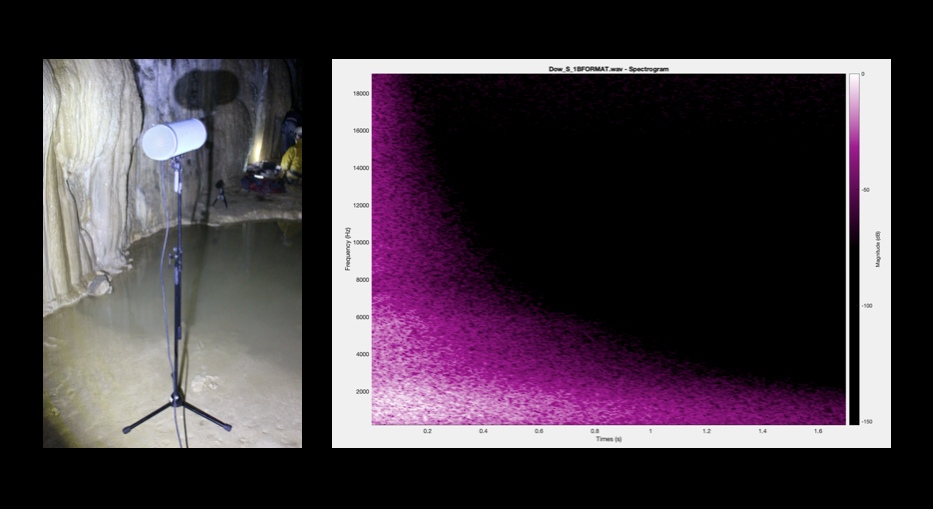
An impulse — such as a starter pistol, balloon pop, or frequency sweep — is used to excite the acoustics of a space. The response that follows contains a detailed acoustic fingerprint of the source–listener relationship, encoded through frequency-dependent resonance and decay characteristics. It is also possible to simulate such impulse responses mathematically from visual or spatial data.
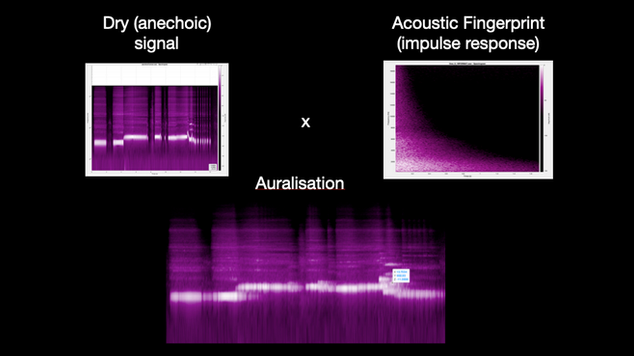
Impulse response information is effectively the sonic equivalent of a three-dimensional digital model of space. Through convolution, an incoming audio signal can be processed using the impulse response of a given environment, placing the listener within a simulated acoustic virtual reality of that space.
Recombinant acoustic architectures
As composers, this allows us to construct recombinant sonic architectures — spaces that morph into one another or exist simultaneously. One might sing into a hybrid skyscraper–duomo–temple–tunnel that gradually transforms into a mineshaft–silo–subway–staircase. Sonically, we can now travel in ways previously reserved for the cinematic eye.
Through forensic acoustics, it becomes possible to reverse-engineer recordings from the past: extracting impulse responses from footsteps in archival film scenes, discovering acoustic signatures revealed by lightning or thunderclaps, or even exploring underwater echoes. Echo can be