VERTICAL TIME
8/16/2025

Premiere for VERTICAL TIME – Cobi van Tonder
16 August 2025
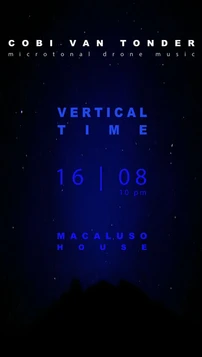
Vertical Time – Design by Nadiya Yamnich
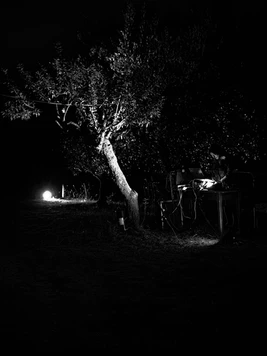
Performance photo © Francesco Zizola
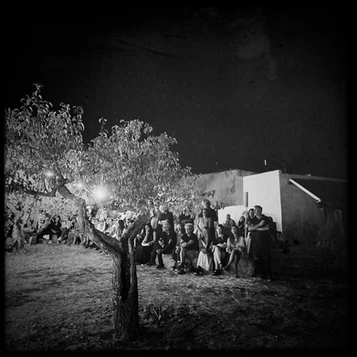
Event photo © Francesco Zizola
I was commissioned by the Transforming Data Reuse in Archaeology (TETRARCHs) project, led by the Department of Archaeology at the University of York, to create the piece you heard this evening. TETRARCHs explores how archaeologists collect data and how that data can be reused for storytelling in ways that are meaningful for diverse audiences.
The project is funded by CHANSE (Collaboration of Humanities and Social Sciences in Europe), a joint initiative of 27 research funding organisations from 24 countries under the European Union’s Horizon 2020 research and innovation programme.
Through the Department of Archaeology at York, in collaboration with the University of Durham and Abu Dhabi’s Department of Culture and Tourism, I was introduced to a research project investigating Bronze Age domestic life at Hili Archaeological Park in Al Ain, UAE — a UNESCO World Heritage Site. The project focuses on the Hafit and Umm an-Nar periods (c. 3200–2000 BCE), addressing longstanding gaps in knowledge around everyday life, domestic architecture, and socio-economic organisation in the region.
Initial excavations in 2022–23 identified preserved archaeological deposits, including mudbrick structures, irrigation systems, and activity areas suggesting cooking and craft production. During the 2023–24 season, I observed the team analysing materials from both earlier and recent excavations, alongside targeted fieldwork using aerial and terrestrial surveys.
Broadly, the Bronze Age in Al Ain began around 3000 BCE, with agricultural villages emerging soon after. Between 2500 and 2000 BCE, settlement and monumental tomb construction expanded significantly during the peak of the Umm an-Nar era. Hili 16 and its associated tombs date firmly to this phase (c. 2700–2000 BCE), making them approximately 4,200–4,700 years old.
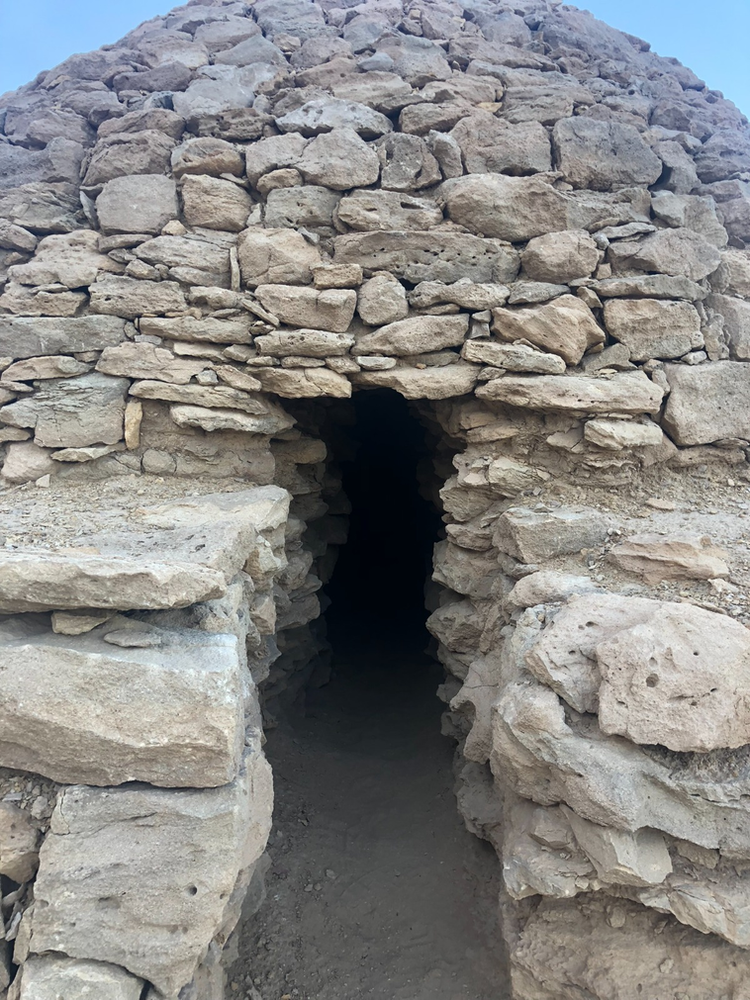
I attended excavations, participated in project meetings, and interviewed archaeologists on site. I also made field recordings of the surrounding area and of archaeology itself — digging, tapping, brushing, scratching — as well as impulse-response recordings of a falaj water system and several Hafit tombs. These small beehive-shaped stone structures represent the earliest Bronze Age burial tradition in southeastern Arabia, marking a shift toward territorial anchoring and social memory.
Talking with the archaeology team, I learned how excavation is fundamentally a destructive process: as layers are removed, they are lost forever, making careful documentation essential. One such system, the Harris matrix, deeply impressed me — particularly its potential to function as a kind of musical score. I observed the intuition archaeologists develop to distinguish subtle layers of dust and earth, using sound cues — tapping on surfaces — to reveal structures buried for nearly five millennia.
In some contexts, digging one millimetre can mean moving through a year — or many years — of time. Sediment accumulation varies enormously, but in some cases, a metre of vertical excavation can reveal a millennium of human activity.
From this, the title of the piece emerged: time layered and buried vertically in the soil. The concept connects directly to my long-term compositional research into microtonal drone music, a shift from horizontal melodic and rhythmic thinking toward vertical layers of frequency suspended in space. The music unfolds slowly, revealing internal pulses and transformations — less like narrative progression, more like watching a sunset.
Standing at Hili 16 at sunrise, observing careful excavation and drifting dust in the wind, Vertical Time was born — a meditation on deep time, memory, and the impossibility of fully reaching the past. I found myself imagining futures thousands of years from now: who or what might one day uncover traces of us?
For me, Vertical Time is about memory and consciousness buried layer by layer in the soil, human fragility and resilience set against the immense depth of time. Time is usually represented horizontally — on musical staves, timelines, calendars. Here, time is vertical, measured in millimetres.
Sound becomes mathematics: frequency as cycles per second. Low frequencies stretch into vast wavelengths, while high frequencies compress into grains as fine as sand. These abstractions led me to imagine sonic deserts and dunes, mirroring the landscapes around Al Ain.
The Rubʿ al-Khālī (Empty Quarter), the world’s largest continuous sand sea, covers some 650,000 km² across the Arabian Peninsula. Its dunes — some rising 300 m — formed over thousands of years. Certain crescent-shaped dunes are known to sing, producing deep resonant tones (typically 80–120 Hz) when sand avalanches or wind-triggered slides occur.
Vertical Time begins in this desert — with wind, with singing dunes (both recorded and synthesised) — and slowly moves through echoes of tombs and falaj tunnels. Layers of abstract frequency clusters emerge: some so high they sting the ears, others manifesting as deep bass felt through the body. These are created through difference-tone pulsing, where interference between frequencies produces rhythmic, physical sensations in space.
The audience is invited to move, to turn their heads, to experience sound as vibration in air and body.
The premiere took place on a warm summer night in the garden of Malacusa House, Fantese, Puglia. Using multichannel surround loudspeakers, the piece unfolded from desert wind and singing dunes into archaeological sounds and dense microtonal frequency clusters. At one point, neighbours reportedly called the police to report a UFO landing — perhaps the best compliment a concert can receive.
I hope to present Vertical Time again, and in many places.